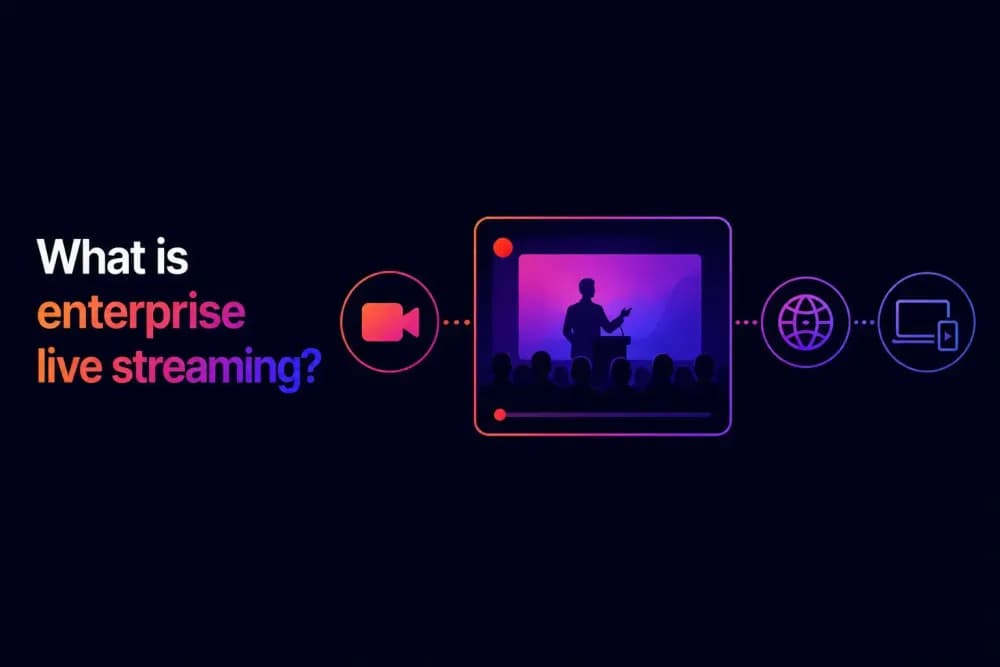
Enterprise live streaming is the delivery of live video content at scale, over the internet, with the security controls, reliability infrastructure, and audience analytics that business use cases require. Where consumer-grade streaming prioritises reach, enterprise live streaming prioritises control, performance, and data. This guide covers how enterprise live streaming works, what separates it from standard broadcasts, and what to look for when choosing a platform.
What is enterprise live streaming?
Enterprise live streaming is a managed approach to broadcasting live video to internal or external audiences, with access controls, encoding pipelines, CDN delivery, and reporting built into the workflow. It is used by organisations that need to distribute live content to employees, customers, partners, or event attendees, while maintaining control over who can view it, how it performs across different connection speeds, and what the audience did during the broadcast.
Running a global all-hands or a paid live training session puts demands on a platform that public broadcasting tools were never designed to meet. The way that live streaming infrastructure affects broadcast quality becomes a real operational concern the moment scale, compliance, or audience distribution enters the picture. Authentication matters, latency targets matter, uptime guarantees matter, and data residency may matter depending on the audience's geography and the organisation's compliance obligations.
How does a live stream reach business audiences?
Enterprise live streaming starts with a video source, which can be a professional camera, a software encoder, a screen capture, or a webcam setup. That source sends a video signal to an ingest server using a streaming protocol, most commonly RTMP (Real-Time Messaging Protocol) or SRT (Secure Reliable Transport). From the ingest point, the platform transcodes the signal into multiple quality levels, so viewers on different devices and connection speeds all receive an appropriate stream.
Delivery happens through a content delivery network (CDN), which routes the stream through servers geographically close to each viewer. This reduces buffering and reduces latency. For large global audiences, CDN infrastructure is what makes the difference between a stable broadcast and one that degrades under load.
At the viewer side, the stream is delivered via an embedded player or a dedicated player application. For enterprise use cases, the player is typically embedded in a controlled environment rather than a public page. This allows the platform to enforce authentication, restrict access by domain or IP, and capture viewer-level engagement data throughout the live session.
After the broadcast, most enterprise live streaming platforms retain the recording and make it available on-demand immediately or after processing. This is where the analytics layer becomes particularly useful. Teams can review who watched, how long they stayed, where they dropped off, and which moments generated the most replays.
What separates business live streaming from consumer broadcasting?
Consumer live streaming platforms optimise for public reach and viewer numbers. Enterprise live streaming optimises for reliability, access control, and data capture. The operational requirements are different at almost every layer of the stack.
Access control is one of the clearest differences. Consumer platforms make content public by default and offer limited restriction options. Enterprise platforms support Single Sign-On (SSO), expiring access tokens, domain restrictions, IP allowlisting, and password-protected streams. For a company broadcasting an internal town hall or a paid subscriber event, these controls are essential.
Analytics depth is another difference that matters operationally. Many consumer platforms report general viewer counts. Enterprise platforms report at the viewer level: who joined, when they joined, when they left, how many times they replayed a section, and whether they clicked on any in-stream elements. This data feeds back into decisions about content format, session length, and audience engagement strategies.
Encoding quality and delivery performance are also calibrated differently. Consumer platforms apply standard encoding to manage costs across millions of streams. Enterprise platforms can support high-resolution delivery (up to 4K or 8K depending on the platform), adaptive bitrate streaming across a defined resolution ladder, and SLA-backed uptime commitments that are not available on public platforms.
What are the most common enterprise use cases for live streaming?
Enterprise live streaming covers a wide range of organisational needs. Internal communications are one of the largest use cases: all-hands meetings, executive briefings, regional town halls, and change management announcements that need to reach employees across multiple time zones simultaneously.
External communications represent another significant category. Product launches, investor days, partner summits, and customer webinars all involve external audiences with specific access requirements. A company streaming its annual results to analysts has different authentication needs from one running a product demo for prospects, but both require the reliability and control that consumer platforms cannot provide.
Learning and development teams use enterprise live streaming for instructor-led training delivered at scale. A single trainer can deliver a live session to hundreds of learners across multiple sites, with the recording automatically available after the session ends. For organisations using a learning management system (LMS), this workflow often connects through SCORM or xAPI to log completion and engagement data back into the learner's record.
Sales and marketing teams use live streaming for webinars and virtual events, where the priority is generating pipeline alongside the broadcast. This is where platforms with in-stream interactivity become relevant: polls, Q&A widgets, and CTA overlays that allow viewers to take action without leaving the stream.
What security and compliance requirements apply to live broadcasts?
Security requirements for enterprise live streaming vary by organisation type and audience. The most common baseline requirements are encrypted stream delivery (TLS/HTTPS), viewer authentication, and access restrictions tied to identity providers.
For organisations operating under GDPR, the processing of viewer data during a live stream, including IP addresses, viewing durations, and engagement events, must comply with data minimisation and consent obligations. Choosing a platform that processes live data within the appropriate geographic region, and that publishes its data processing agreements clearly, is part of the procurement decision.
For organisations in regulated industries, such as financial services or healthcare, additional requirements may apply. Audit logs, data retention policies, and restrictions on which personnel can access viewer-level data are typical requirements in these environments. Some organisations also require the ability to stream over private networks or through a secure tunnel, bypassing the public internet for particularly sensitive broadcasts.
ISO certification is a signal worth checking when evaluating platforms. ISO 27001 covers information security management and indicates that the vendor has a formal, audited approach to protecting the data that flows through its infrastructure.
How does Cinema8 support enterprise live streaming?
Cinema8 is a secure video hosting platform that includes live streaming as part of its broader video management infrastructure. Teams use Cinema8 to broadcast live sessions with access controls, embed the live player inside authenticated environments, and capture viewer-level engagement data during the broadcast.
One capability that separates Cinema8 from basic live streaming tools is the ability to add interactive elements to live broadcasts. Teams can layer in polls and quizzes that run alongside the live stream, giving facilitators a way to collect audience responses in real time. This is particularly useful for training sessions and webinars where engagement data matters as much as delivery.
Cinema8 holds ISO 27001 certification for information security management and is BESA accredited, which makes it a suitable platform for organisations with formal procurement requirements. The platform scales from smaller team broadcasts through to large enterprise deployments, with SSO, domain restrictions, and webhook integrations available for teams that need them. Visit Cinema8 to start live streaming your enterprise content.
What should you look for in a business platform with live streaming?
Choosing a live streaming platform for business use is as much an infrastructure decision as a features decision. How the platform handles delivery under load, what its SLAs cover, and how its data practices align with your compliance obligations matter as much as the live streaming feature list.
Engineering teams evaluating platforms should look at ingest protocol support (RTMP and SRT are both standard expectations), transcoding options, CDN reach, API access, and webhook availability. A platform that exposes a REST API gives engineers the flexibility to build live streaming into existing product workflows without being tied to a single player or front-end.
Marketing and communications teams tend to prioritise the viewer experience and what comes out of it analytically. A branded player, a clean embed that works inside existing web properties, viewer-level engagement data, and the ability to add CTAs or lead capture elements inside the stream are the capabilities that change how useful the platform is after the first few events.
Reliability deserves its own evaluation, separate from features entirely. A platform that performs well for pre-recorded video does not automatically handle the demands of a live broadcast. Test with realistic audience sizes before committing to a platform for anything high-stakes.
What happens after a live stream ends?
A live stream recording becomes an on-demand asset the moment the broadcast ends. It can be organised into a video library, shared with viewers who missed the live session, and reviewed for engagement patterns that shape future content decisions.
Viewer-level analytics from the session show where attention held, where it dropped, and which moments generated replay behaviour. That data is useful both for editing the recording before redistribution and for understanding which topics landed with the audience.
The downstream integrations are where the workflow either connects or breaks. Completion data from training sessions can pass to an LMS through SCORM or xAPI automatically, so the live event logs against formal learning records without manual intervention. Lead data captured through in-video forms during the stream can push directly to a CRM through webhook integrations, keeping pipeline data clean from the moment the session ends.
What is the difference between enterprise live streaming and video conferencing?
Video conferencing platforms like Zoom and Microsoft Teams are built around interactive participation as their primary model. They offer broadcast or webinar modes with restricted attendee controls, but the underlying architecture is designed for bidirectional communication, and the toolset reflects that. Attendee management, breakout rooms, and real-time collaboration are the core experience.
Enterprise live streaming is a broadcast architecture first. One presenter or a small production team delivers to a large audience, and the platform optimises for delivery quality, audience scale, and viewer-level data capture. Viewers can participate through polls, Q&A widgets, or interactive overlays, but the infrastructure is built around one-to-many delivery rather than real-time participation.
The two are often used together. An organisation might use a video conferencing tool to manage the presenter side of a production and route that output into a live streaming platform for delivery to the wider audience. That separation keeps the control room workflow clean and lets each tool handle what it was designed for.
What is the future of enterprise live streaming?
Enterprise live streaming is moving toward tighter integration between the broadcast itself and the data workflows that surround it. Real-time analytics during a live session, automatic post-event processing, AI-generated transcripts and chapter markers, and direct integrations with CRM and LMS platforms are becoming standard expectations from enterprise buyers.
Interactive features within the live player are also growing as a standard expectation. Organisations that previously ran live webinars as linear broadcasts are now looking for ways to collect structured responses, route viewers to relevant follow-up content, and attribute pipeline directly to live streaming events. The platforms that support this without requiring custom development work are gaining ground with marketing and L&D teams that need results without large technical overhead. Book a demo to see how Cinema8's video hosting platform handles enterprise live streaming.