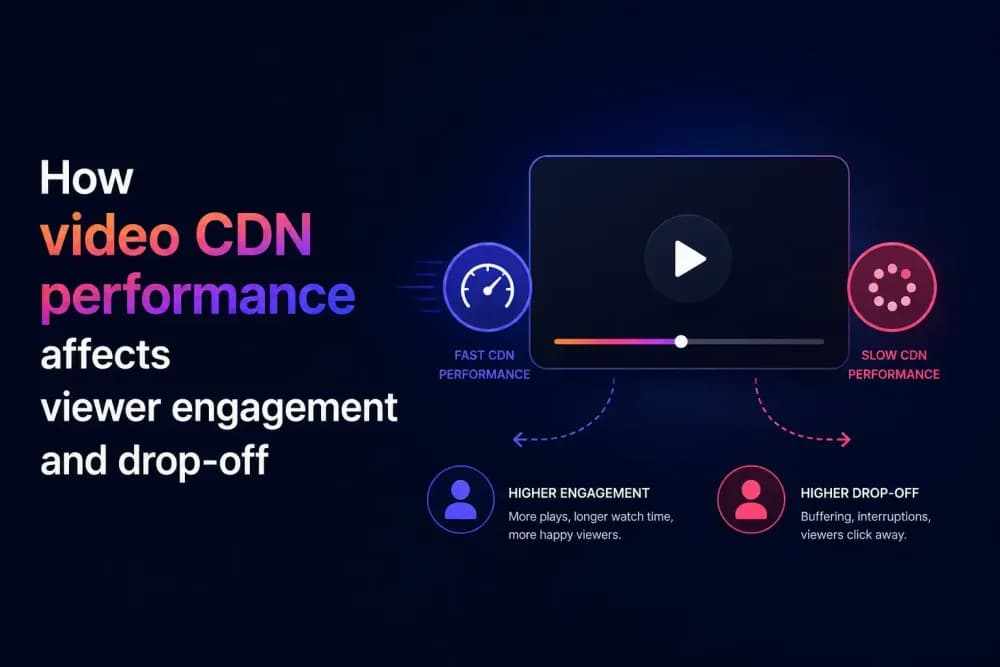
Video CDN performance determines how quickly video content reaches the viewer's device. Poor delivery causes buffering, resolution drops, and slow start times, which directly raise drop-off rates. This guide explains how video CDN performance affects viewer engagement, what drives delivery failures, and what to look for in video hosting platforms.
What is CDN performance in video delivery?
A content delivery network (CDN) is the infrastructure that routes video files from origin servers to viewers around the world. CDN performance refers to how reliably and quickly that delivery happens, across geographic locations, device types, and varying network conditions. For businesses using video hosting, smooth uninterrupted playback means the CDN is functioning correctly. Buffering at the ten-second mark, unexplained resolution drops, or a stream that fails to start entirely all point to a CDN performance issue somewhere in the delivery chain.
Video delivery relies on a network of edge servers positioned at locations across the world. Rather than serving every viewer request from a single origin server, a CDN routes each request to the nearest edge node. That reduction in physical distance lowers latency and improves the speed at which the first video frame appears on screen. Time-to-first-frame, buffering frequency, and bitrate stability are the delivery metrics that shape what viewers experience. Watch time, drop-off, and completion rates are how that experience shows up in engagement data.
How does poor CDN performance raise video drop-off rates?
Video CDN performance affects viewer drop-off at every stage of playback, from the moment a viewer presses play through to the final frame. Slow start times are the first major drop-off point. For businesses embedding video on landing pages or sending video in outbound campaigns, a delayed start occurs before the content has delivered any value. That makes start time the most costly delivery failure in any video strategy.
Mid-stream buffering produces a different pattern of viewer loss. Most viewers will wait through one buffering event. Two within the same session is typically enough to end it, regardless of how strong the content is. A video with strong content but weak CDN delivery is likely to show high drop-off rates even when the production quality is good.
Resolution instability is a more subtle cause of viewer loss. When adaptive bitrate streaming drops a video from 1080p to 360p mid-stream because the CDN cannot sustain the bitrate, the quality drop is visible on most modern displays. For businesses using video for product demos, onboarding, or marketing content where visual clarity carries meaning, that degradation undermines the credibility of the content regardless of how well it was produced.
Cinema8's secure video hosting platform, delivers hosted video through global CDN infrastructure with adaptive bitrate streaming. The player adjusts quality levels without triggering full buffering events as network conditions change.
What causes poor CDN performance in video streaming?
Poor CDN performance in video delivery comes from identifiable sources at different layers of the delivery chain.
- Server proximity is the most straightforward cause. A viewer accessing video hosted exclusively on servers in one region will experience higher latency if they are located far from the nearest edge node. CDNs with limited geographic coverage cannot serve international audiences at consistent quality. For businesses distributing content to teams or customers across multiple countries, coverage gaps in the delivery network create predictable performance degradation in specific regions. Those degraded regions show up in viewer analytics as clustered early drop-off, which can be misread as a targeting or localisation problem.
- Network congestion occurs when simultaneous demand exceeds what the CDN's edge nodes can process at a given moment. This is common during high-traffic product launches, live-stream events, or campaigns where many viewers request the same content simultaneously. A CDN with limited burst capacity handles this by throttling delivery, which means all viewers experience degraded performance rather than individual connection failures being isolated and absorbed.
- Encoding configuration is a hosting-side factor that CDN performance alone cannot compensate for. If a video is uploaded and transcoded into only one or two quality levels, the adaptive bitrate player has very few options to switch between. A viewer on a slower connection may be dropped to an unusable resolution because no appropriate intermediate rendition exists. Well-configured video hosting platforms transcode uploaded video into multiple renditions across a broad quality range, so the player can maintain clarity without a visible collapse in quality.
- Infrastructure limits at the hosting provider level create the least visible but most consequential performance issues for growing businesses. Providers that apply per-account bandwidth caps, share CDN infrastructure across many customers, or operate from a limited number of delivery regions cannot guarantee consistent performance as audience scale increases. Businesses that outgrow a limited hosting plan frequently discover CDN degradation at exactly the moment their audience is largest. Enterprise video hosting requirements typically include dedicated bandwidth allocation, multi-region delivery, SSO support, and domain restrictions. A provider that cannot demonstrate these capabilities at the evaluation stage is unlikely to meet them at scale.
Which CDN performance metrics matter most for video?
Tracking CDN performance for video means knowing which measurements map directly to the viewer experience. Five metrics consistently predict whether viewers complete a video or leave early, and each one reflects a different point in the delivery chain.
- Time-to-first-frame (TTFF) measures how long a viewer waits between pressing play and seeing the first frame of video content. TTFF under one second is the target for most hosted video scenarios. Above two seconds, the risk of early abandonment rises measurably. For short-form video content where the first three seconds carry the highest intent signal, TTFF is the most operationally important metric to track.
- Buffering ratio measures the proportion of total playback time spent loading data rather than playing content. A buffering ratio above 1% indicates a delivery problem. At 2% or above, video completion rates tend to decline and viewer satisfaction drops measurably across all content types. For marketing teams that use video completion as a signal of buyer intent, a high buffering ratio introduces noise into engagement data because buffering events appear in analytics as voluntary viewer drop-off rather than delivery failures.
- Video start failure rate captures the percentage of play attempts that result in no video starting at all. This metric is absent from many standard analytics dashboards but is one of the clearest indicators of CDN instability. A viewer who presses play and sees a persistent loading state before giving up is counted as a failure as opposed to a drop-off. The distinction is important because start failure reflects a complete delivery breakdown, and requires a different response.
- Bitrate average and variability reflect the quality level delivered to viewers across a session. When average bitrate is high and variability is low, most viewers are watching at the intended resolution without quality switching. Sharp variability in bitrate indicates the CDN is struggling to maintain steady delivery, which produces visible disruptions in playback that viewers attribute to the content rather than the infrastructure.
- Geographical performance variation shows whether CDN delivery quality is consistent across viewer locations or whether certain regions experience systematically worse conditions. For businesses with distributed audiences across sales teams, partner networks, or customer bases in multiple countries, regional variation in this metric is a direct measure of the CDN's point-of-presence distribution and coverage density.
What should a video hosting platform provide for reliable CDN delivery?
Reliable CDN delivery depends as much on the video hosting platform as it does on the delivery network itself. Every uploaded video should be transcoded into multiple quality renditions so the adaptive bitrate video player has meaningful options to work with. Without a full rendition range, ABR functions in name only. Viewers on variable connections drop to the lowest available quality tier rather than an appropriate intermediate level.
Transparent bandwidth allocation matters for businesses scaling their video use. Many hosting plans impose per-account bandwidth limits, and some providers throttle delivery when those limits are approached. Cinema8's plans include defined bandwidth allocations, from 500 GB per month on the free tier to 2 TB on Pro, with larger allocations on Pro Plus and Enterprise plans. Cinema8 is ISO 27001 certified for information security management and scales from individual users through to enterprise teams with SSO, domain restrictions, and unlimited seats.
Delivery architecture decisions are not always visible to buyers before they sign up. Evaluating a hosting platform for CDN performance means asking the video hosting platform the right questions about the underlying delivery network, the regions it covers, and whether shared infrastructure is used across accounts. Platforms built on major CDN providers with global edge coverage deliver more consistent performance than those routing through a small number of centralised servers.
How does CDN performance affect video SEO and page load scores?
On pages where a video player or thumbnail is the largest above-the-fold element, slow CDN delivery can push Largest Contentful Paint above the 2.5-second threshold that Google uses to classify page performance, affecting both organic rankings and paid ad quality scores. This is particularly relevant for businesses running paid campaigns that embed video on landing pages, where a poor LCP score raises cost-per-click and reduces ad reach at the same time as it raises viewer drop-off.
Poor CDN performance also weakens video indexation signals indirectly. Search engines assess video content partly through engagement signals including average watch time and completion rate. A video that consistently buffers will show lower average watch time across all sessions regardless of content quality, which reduces the engagement signal that search engines use to assess relevance. For businesses investing in video SEO, delivery quality and content quality are not separate problems.
Cinema8's video SEO tools include SEO-ready embeds and structured data support for hosted video, giving marketing teams the metadata tools alongside the CDN infrastructure.
What to do when CDN performance is holding back your video results
The most practical diagnostic step when video engagement data looks poor is to separate delivery problems from content problems before acting on either. The pattern of drop-off is the clearest signal. If viewers are leaving in the first two seconds across all regions and device types, the issue is delivery. If drop-off happens at a consistent point in the narrative regardless of where or how someone is watching, the issue is the content. Acting on one when the problem is the other leads to the wrong fix.
Viewer-level analytics are the tool that makes this separation possible. Cinema8's engagement heatmaps show where viewers stop watching, broken down to the individual session.
Building video hosting strategy around CDN performance from the start removes the delivery variable from engagement analysis. Teams that choose a platform with the right infrastructure get engagement data that reflects what viewers actually think of the content, which is the only data worth optimising against.
Create a Cinema8 account and start your free trial to explore video hosting with global CDN delivery and viewer-level analytics. No credit card required.