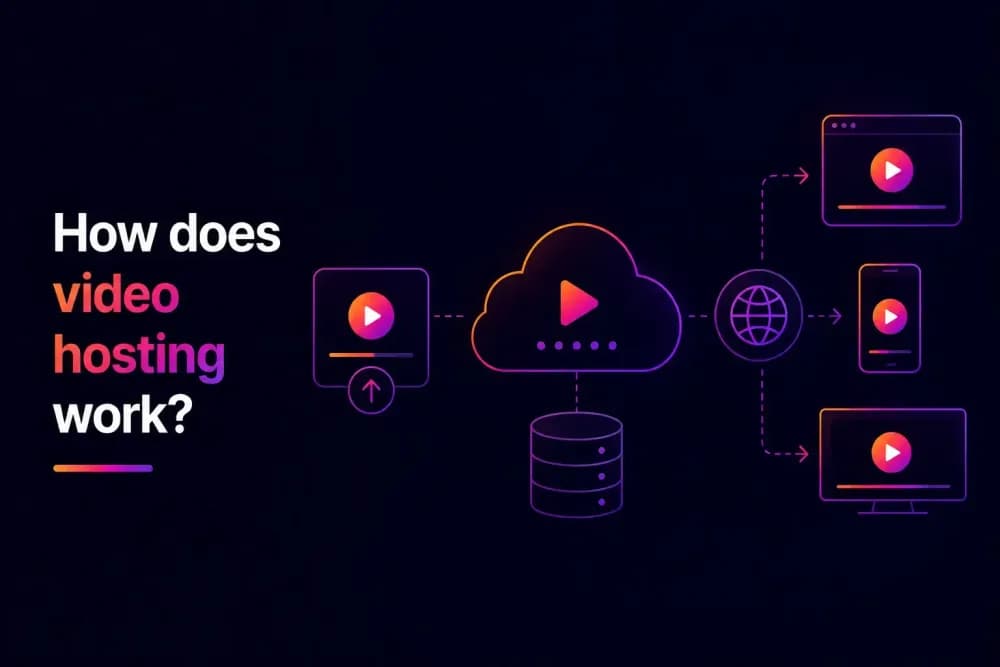
Video hosting works by processing and storing uploaded video files, then delivering them to viewers when they press play. A hosting platform manages the technology required to make videos available online across different devices and connection speeds. This article explains the complete video hosting process, from upload and storage to delivery, playback, publishing, and analytics.
What is video hosting?
Video hosting is a service for storing, managing, and delivering video content online. Once a video is uploaded, the hosting platform prepares it for streaming and provides the infrastructure needed to deliver it when someone presses play.
Understanding how video hosting works starts with what happens between the original upload and playback. The platform handles processes such as transcoding, storage, streaming, player configuration, access management, and analytics. Together, these processes allow videos to reach viewers across different devices, locations, and network conditions.
How does a hosting platform process an uploaded video?
A hosting platform processes an uploaded video by preparing the source file for online streaming and playback. The source file has properties such as its resolution, bitrate, codec, and file size, which influence how it needs to be processed.
One of the main stages of video upload and processing is transcoding. This creates versions of the source video at different resolutions and bitrates, giving the platform suitable files for different devices and connection speeds.
Transcoding can also prepare the video for streaming protocols used for online delivery. Once processing is complete, the resulting files can be stored and made available to the platform's delivery infrastructure.
How are hosted videos stored?
The files created during processing need to remain available whenever somebody requests the video. Video storage provides the persistent layer behind this part of the hosting process.
Storage requirements depend on factors including the number of videos, their duration and quality, and the versions retained by the platform. A growing business video library can therefore require considerably more storage than the combined size of its original uploads.
Storage is one component of hosting. Stored files still need infrastructure for processing, delivery, playback, management, and measurement. This is why cloud file storage and a dedicated video hosting platform fulfil different functions.
Cinema8's video hosting platform, for example, measures storage and delivery bandwidth separately within its hosting plans. Storage accounts for media kept on the platform, while bandwidth measures the data transferred as audiences watch it.
How are hosted videos delivered to viewers?
When a viewer presses play, the hosting platform needs to transfer video data from its infrastructure to the viewer's device. Video delivery is the part of the process responsible for getting that data to the audience efficiently.
Many hosting platforms use a video CDN, or content delivery network, to distribute video across different geographic locations. A CDN uses a network of servers so that every viewer does not have to retrieve content directly from the same origin server.
This becomes particularly important when businesses have audiences spread across multiple regions. The delivery system needs to handle simultaneous requests while keeping playback responsive as traffic and viewer locations change. Video streaming also allows playback to begin while content continues to be delivered. The viewer does not normally need to download the complete original video file before watching it.
Cinema8 uses global CDN delivery as part of its video hosting infrastructure, alongside scalable storage and bandwidth for business video.
How does adaptive bitrate streaming work?
Network conditions can change throughout a viewing session. A connection that comfortably supports high-resolution playback at one moment may have less bandwidth available later.
Adaptive bitrate streaming uses the different renditions created during video processing to respond to these conditions. The player can request a rendition suited to the available bandwidth and switch between quality levels as conditions change.
The aim is to maintain continuous playback while providing an appropriate level of video quality. Cinema8 uses adaptive streaming within its hosting infrastructure to support playback across different network conditions.
This connection between processing and delivery is central to how video hosting works. Transcoding creates the available renditions, storage keeps them accessible, and the delivery infrastructure supplies the appropriate stream during playback.
How does a video player work with a hosting platform?
The video player is the part of the hosting system that viewers interact with directly. It presents the video on a webpage, watch page, application, or other digital environment and provides the controls required for playback.
The player communicates with the hosting and delivery infrastructure when video is requested. It can manage functions such as starting and pausing playback, seeking through the video, adjusting volume, and selecting available playback options.
Depending on the platform and configuration, the video player may also provide subtitles, quality settings, playback speed controls, branding, or interactive elements. For businesses, player configuration determines how hosted content appears within the wider digital experience. Cinema8 provides an ad-free, customisable player, allowing organisations to control branding and presentation across their hosted content.
How do you publish and share a hosted video?
Once processing is complete, the hosted video needs a way to reach its intended audience. Businesses can publish the same hosted asset across different environments without uploading a separate video file for each destination.
Common distribution and access methods include:
- Embedding the video on a website. An embed places the hosting platform's player within a webpage while the underlying video remains on the provider's infrastructure. The hosting platform continues to handle streaming and delivery while the viewer watches from the business's website.
- Sharing the video through a link. A hosted video can be distributed through a direct or dedicated viewing link. Links are useful for email, messaging platforms, client communications, and other situations where placing an embedded player within the destination is not practical.
- Connecting video with other platforms. APIs and integrations can bring hosted video into applications, learning environments, content management systems, and other business software. The hosting service continues managing the media while the video is incorporated into the organisation's existing systems.
- Controlling access to the video. Some platforms allow businesses to restrict who can view content or where it can appear. Cinema8 supports controls including password protection and domain restrictions for videos that should not be freely available everywhere online.
The publishing method can therefore change without changing the underlying hosting process. The platform continues to store and deliver the video while businesses determine where and how audiences encounter it.
What data does a video hosting platform collect during playback?
A video hosting platform can collect data about how viewers watch and interact with a video during playback. This data is recorded within the platform and made available through video analytics for reporting and analysis.
The exact metrics available depend on the provider and plan, but a video hosting platform may measure:
- Views and viewer activity. View counts provide a basic indication of how often content is watched, while more detailed analytics can distinguish between viewing sessions or individual viewers.
- Watch time and completion. These metrics show how long audiences spend watching and how frequently they reach the end. They can help teams assess whether viewers remain engaged for the parts of the video that are important.
- Engagement and drop-off. More detailed reporting can show where viewer attention changes throughout a video. Teams can identify sections that retain viewers and points where a noticeable proportion of the audience stops watching.
- Device and playback information. Technical analytics can provide information about the devices, browsers, and environments used to access content. This can help businesses understand how audiences are watching their videos.
- Viewer and interaction data. Platforms with viewer-level or interactive analytics can record additional actions within a viewing session. These might include clicks, form submissions, answers, or other interactions built into the video.
The value of this data depends on how the video is being used. A marketing team may focus on engagement with a campaign video, while an internal training team may be interested in completion and individual viewing activity.
Cinema8 provides video analytics covering viewing and engagement behaviour, with additional capabilities such as heatmaps and interaction reporting available for more detailed analysis.
Why use a video hosting platform instead of hosting on your website?
A website can technically serve a video file from its own server. Doing so means the website's infrastructure has to handle the storage, bandwidth, processing, and delivery requirements created by that content. Several challenges become more significant as the video library and audience grow:
- Video files can consume substantial storage. High-resolution videos are considerably larger than most standard website assets. Maintaining a growing library can quickly increase the storage required from the web server or hosting environment.
- Video playback can generate heavy bandwidth usage. Each viewing session requires data to be transferred to the viewer. A popular video or a sudden increase in simultaneous viewers can create a much larger delivery workload than normal webpage traffic.
- Different viewing conditions require different video versions. Serving one large source file gives the delivery system little flexibility when viewers have different devices or connection speeds. Dedicated hosting platforms can create multiple renditions for adaptive playback.
- Global audiences require suitable delivery infrastructure. Viewers may be located far from the server hosting the original file. CDN infrastructure helps distribute video delivery across regions and reduces reliance on a single server location.
- Video management introduces additional requirements. Businesses may need player controls, privacy settings, analytics, subtitles, embeds, integrations, and other functionality as their use of video develops.
Using a dedicated platform moves these video-specific requirements into infrastructure built to handle them. The business's website can display the hosted player while the video platform manages processing, streaming, and the underlying media files.
This separation becomes increasingly useful as organisations publish more content, reach larger audiences, or need greater control over how videos are delivered and managed.
How does Cinema8 handle video hosting?
Cinema8 provides the core infrastructure businesses need to host and deliver video online. Its approach reflects how video hosting platforms work, with tools for uploading and managing content, storing video libraries, and delivering videos through global CDN infrastructure.
Adaptive streaming supports playback across different network conditions, while the ad-free player gives businesses control over how their videos are presented. Security controls can also be applied when content needs restricted access or controlled distribution.
The hosting environment connects with other parts of the video workflow, including analytics, AI tools, interactive video features, APIs, and integrations. Businesses can therefore manage the video after it has been processed and published without moving the asset between separate systems.
Storage and bandwidth requirements can also change as the organisation's library and audience grow. Cinema8 provides different hosting plans to accommodate businesses with different levels of video usage.
Understanding how video hosting works
Understanding how video hosting works means looking at the complete journey of a video after it enters a hosting platform. The original file is processed into suitable streaming formats, stored, delivered through video infrastructure, and presented to the viewer through an online player. Publishing tools then determine where audiences can access the video, while analytics provide information about what happens during playback. Together, these processes allow businesses to deliver online video without building and maintaining their own streaming infrastructure.
The right hosting environment should support the way your organisation uploads, delivers, protects, manages, and measures its content as video usage grows. Explore Cinema8's video hosting plans or book a demo to see how Cinema8 manages video from upload through to delivery and analysis.