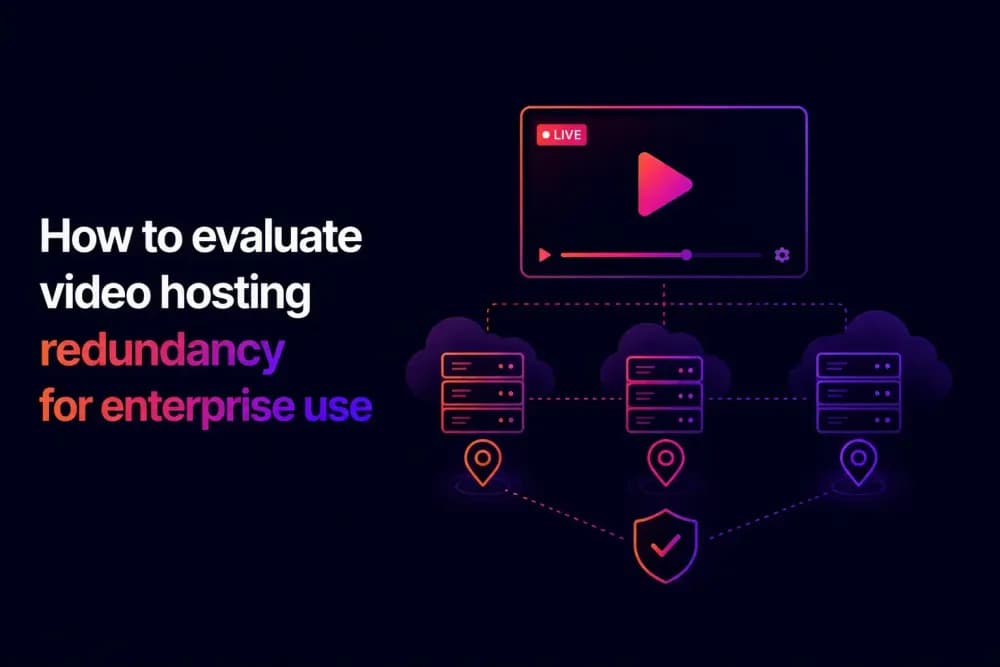
Video hosting redundancy is the infrastructure practice of duplicating delivery systems so that if one component fails, another takes over without interrupting playback. For enterprise teams, redundancy determines whether video content remains accessible during outages, traffic spikes, or regional network failures. This post explains how video hosting redundancy works, what forms it takes, and how to evaluate it when choosing a platform for business-critical content delivery.
What is video hosting redundancy and why is it important?
Video hosting redundancy refers to the deliberate duplication of storage, encoding, and delivery infrastructure so that no single point of failure can take down content delivery entirely. A platform without redundancy relies on a single server or delivery path. If that path fails, playback stops. A platform built with redundancy routes around failure automatically, maintaining delivery without the viewer or the enterprise team noticing anything has gone wrong.
For enterprise teams, the stakes of a delivery failure extend well beyond a buffering icon. Video sits inside workflows that carry direct commercial consequences. A sales team relying on video in a live product demonstration cannot recover a lost deal caused by a platform outage. A compliance training programme that fails to deliver mandatory content on schedule creates a liability gap. A customer onboarding video that fails to load on a prospect's first day sets a poor precedent for the relationship. Video hosting redundancy, delivered through secure video hosting platforms like Cinema8, is the infrastructure layer that keeps these scenarios from becoming business problems.
What are the main types of video hosting redundancy?
Video hosting redundancy operates at several levels of the delivery stack. Understanding each one helps enterprise teams ask the right questions when evaluating a provider.
- Storage redundancy means video files are copied across multiple servers or data centres. If a primary storage location becomes unavailable, the platform retrieves content from a backup without manual intervention. Platforms that store video in a single location introduce a fragility that no amount of CDN investment can fully compensate for.
- Encoding redundancy applies to the process of converting uploaded video into playable formats. When an encoding pipeline fails on a non-redundant platform, video either does not process or delivers in degraded quality. Redundant encoding pipelines run parallel processes so that a failure at one stage does not block delivery.
- CDN redundancy is the most visible form of video hosting redundancy for end viewers. A content delivery network routes video from the nearest server node to the viewer's device. A platform with a single CDN partner has a single point of failure at the delivery layer. Platforms with multi-CDN architecture can switch between providers automatically when one experiences degradation, maintaining playback quality regardless of the underlying network event.
- Origin redundancy covers the servers that store and serve the master copy of each video file. Multi-origin architecture means that if a primary origin server goes offline, a secondary origin handles requests without manual failover.
Each of these layers is independent. A platform can have CDN redundancy but no storage redundancy, or strong origin failover but a single encoding pipeline. Enterprise teams should ask about each layer specifically.
How does CDN failover protect enterprise content delivery?
CDN failover is the mechanism that switches video delivery from one network path to another when the primary route degrades or fails. In practice, it works through health checks that monitor CDN node performance in real time. When a node's response time exceeds a threshold or returns errors, the platform's routing logic redirects traffic to an alternative node automatically.
The speed of this failover is important. A CDN failover that takes thirty seconds to complete will still produce a visible interruption for viewers already mid-playback. Platforms built for enterprise content delivery implement failover within seconds, often below the threshold that triggers a visible buffering event for the viewer.
For enterprise teams with globally distributed audiences, CDN failover also intersects with geographic routing. A regional CDN outage in one part of the world should not affect playback quality for viewers in unaffected regions. Multi-CDN platforms with regional failover ensure that a problem in one geography stays contained.
What questions should enterprise teams ask about video hosting redundancy?
Redundancy is an infrastructure commitment, and providers that have made it will be able to answer specific questions with documentation. Before committing to a platform for enterprise content delivery, the following questions will surface the quality of its redundancy architecture and the reliability metrics you'd be able to track:
- Does the platform use multi-CDN delivery, and which CDN partners does it work with?
- How is CDN failover triggered, and what is the typical failover time?
- Are video files stored across multiple data centres, and in which regions?
- Does the platform use redundant encoding pipelines, or does encoding run through a single process?
- What is the origin server architecture, and how is origin failover handled?
- Is redundancy available on all plans, or only at enterprise tier?
- Can the provider share historical incident data showing how redundancy has performed during past outages?
A provider that answers these questions with specifics such as CDN partner names, failover times, or data centre locations, has built its infrastructure to withstand real-world failure scenarios. Providers that respond with marketing language and no supporting data are a signal worth acting on before a contract is signed.
How does video hosting redundancy relate to uptime guarantees?
Uptime and redundancy measure different things, though they are closely related. Video hosting uptime is a measure of how often a platform is available, typically expressed as an annual percentage. Video hosting redundancy is the infrastructure mechanism that makes high uptime achievable and sustainable under pressure.
A platform can publish a 99.9% uptime SLA without having meaningful redundancy in place. If outages are rare but long, the annual percentage may still look acceptable even though individual events cause significant disruption. A platform with strong video hosting redundancy is more likely to prevent outages from occurring in the first place, and to limit their duration when they do occur, because failover systems activate before a full outage develops.
Enterprise teams should treat uptime figures and redundancy architecture as complementary evaluation criteria. A strong SLA supported by documented redundancy is a more credible commitment than either figure in isolation.
How Cinema8 supports enterprise video delivery
Cinema8 supports enterprise content delivery through global video CDN infrastructure, adaptive bitrate streaming, and viewer-level video analytics that give teams visibility into playback performance across their entire library. Teams can identify delivery issues at the viewer level before they become widespread problems, which is a materially different capability from platforms that report only surface-level playback statistics.
For enterprise teams with security and access control requirements, Cinema8 supports SSO, domain and IP restrictions, private and expiring links, and encrypted streaming, all underpinned by ISO 27001 certification for information security management. The platform scales from self-serve plans through to enterprise deployments with unlimited seats, dedicated support, and custom infrastructure requirements. A 14-day free trial is available on all paid plans with no credit card required, and enterprise teams can book a demo to discuss specific delivery and redundancy requirements directly.
What happens when video hosting redundancy fails?
Even well-architected redundancy systems encounter scenarios they were not designed to handle. Understanding what failure looks like in practice helps enterprise teams build appropriate contingency plans alongside their platform evaluation.
When CDN failover is slow, viewers experience extended buffering. This is particularly damaging for enterprise live streaming scenarios, where there is no opportunity to retry from a cached version. For on-demand content, most players will attempt a retry automatically, but the viewer experience depends on how quickly the platform resolves the routing issue.
When storage redundancy fails, video files become temporarily inaccessible. This scenario is rare on platforms with multi-region storage, but it becomes more likely when a platform relies on a single cloud storage provider without a backup. Enterprise teams hosting large libraries of business-critical content should ask specifically whether their video files are replicated across independent storage systems, not only within a single provider's infrastructure.
When encoding redundancy is absent, newly uploaded video may fail to process during a pipeline outage. For enterprise teams with regular publishing schedules, this creates a backlog that affects content calendars and internal deadlines. Redundant encoding pipelines process in parallel, reducing the window during which an encoding failure affects content availability.
What good video hosting redundancy looks like as infrastructure expectations rise
Enterprise teams are asking more precise questions about delivery infrastructure than they were two years ago. The shift is partly driven by video's expanded role in revenue-generating and compliance-critical workflows, where failure has measurable consequences beyond viewer frustration.
The baseline expectation has moved from headline uptime figures toward documented redundancy architecture, transparent incident communication, and account-level monitoring tools that give teams visibility into their own delivery performance.
Cinema8 treats video hosting redundancy as a structural commitment, documented and verifiable, making it positioned to support enterprise content delivery at scale. Book a demo today to see how Cinema8 can support your business's video infrastructure.