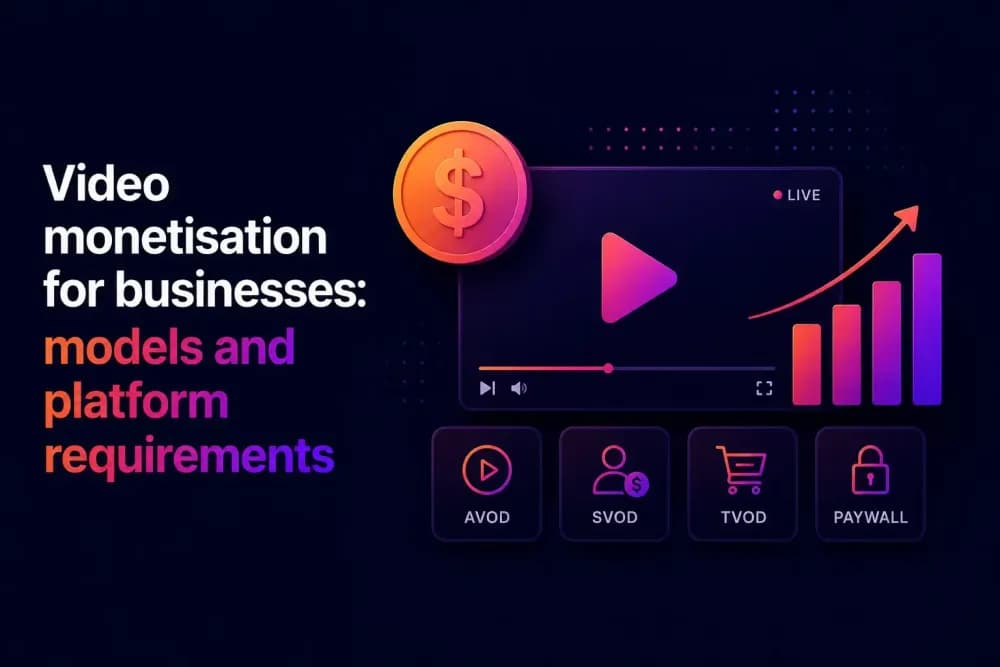
Video monetisation for businesses turns hosted video into direct revenue via advertising, subscriptions, licensing or lead capture. Cinema8, a secure video hosting platform, supports these models through built-in analytics and CRM-connected forms. This article covers the main monetisation models, what a monetisation-ready platform needs, and how to choose between them.
What is video monetisation for businesses?
Video monetisation for businesses means generating direct income from hosted video content through advertising, subscriber access, licensing fees, or in-video lead capture. Each model depends on different platform capabilities, from ad insertion and secure playback controls to the CRM-connected lead forms Cinema8 provides for video monetisation. Most businesses combine two or three models. Audience size and content type both affect which model performs best.
A business with a small, loyal audience typically earns more from subscriptions or licensing than from advertising, since ad revenue depends on volume. A business publishing product demos or training content often earns more from the leads a video generates than from the video itself.
How does monetising video content work for businesses?
Monetising video content works by attaching a revenue mechanism to a specific point in the viewing experience. A short product demo under five minutes rarely tolerates a mid-roll ad break, since most viewers watch it in one sitting and any interruption drops completion. A forty-minute training module can carry two or three natural breaks, since viewers already expect pauses in longer content.
The same logic applies to lead capture. Timing determines whether a form gets seen at all. A form appearing before a viewer has decided the content is worth their time gets ignored or closed. Drop-off data shows the point where attention is highest, and that point is where a lead form actually converts. Platforms that track only total view counts cannot show where that point is. This is why hosting platform choice shapes monetisation strategy directly.
What are the main video revenue models for businesses?
Most businesses choose from five core revenue models, often combining more than one. Each model suits a different content type and audience size, so it helps to see the specific trade-offs before picking one.
- Advertising-supported monetisation. Revenue comes from VAST or VPAID ad formats delivered before, during, or after a video, tied to impressions across desktop, mobile, and connected TV. This model needs meaningful view volume to generate real income, and mistimed mid-roll placement can reduce watch-through rates significantly.
- Subscription access. Viewers pay recurring fees for gated content. This model depends on enforced access controls, since unmanaged password sharing quietly erodes subscription revenue over time.
- Pay-per-view and licensing. Businesses sell individual videos or licence footage for reuse. Secure, token-based playback links are required here, since a shared direct file link bypasses any paywall completely.
- Lead-generation-driven monetisation. Revenue comes from converting attention into sales pipeline rather than from viewer payment. Cinema8's video hosting platform supports this with over 500 drag-and-drop widgets for embedding forms directly inside a video, feeding leads straight into a connected CRM.
- Hybrid models. Many businesses run free, ad-supported content that upsells viewers into a paid tier. Segment-level analytics are what make this approach workable, since they show which viewers are close to converting.
What does a monetisation-ready hosting platform need?
A monetisation-ready video hosting platform for businesses needs three things working together: viewer-level analytics, secure delivery and good redundancy practices, and CRM connectivity. Analytics that stop at total view count cannot show which segment of an audience is worth converting into a paying customer or a lead.
Secure delivery matters most for licensing and subscription models, where content has commercial value on its own. Domain restrictions, access controls, and ISO 27001-certified infrastructure protect that value from unauthorised redistribution. CRM connectivity closes the loop for lead-generation-driven monetisation, since a form embedded in a video is only useful if the lead it captures reaches a sales team automatically.
How does Cinema8 help businesses monetise video?
Cinema8 supports video monetisation through VAST and VPAID ad integration, shoppable video with in-player checkout, and subscription or pay-per-view access, protected by password protection, domain restrictions, and tokenised access. Its real-time analytics dashboard tracks revenue and viewer interaction across every monetised video.
Cinema8 does not include a native payment gateway, so subscription and pay-per-view billing runs through a connected third-party provider. Cinema8 is ISO 27001 certified for information security management, and offers a 14-day free trial on all paid plans with no credit card required.
Video monetisation vs advertising revenue: what's the difference?
Advertising revenue is one video monetisation model, generated through VAST or VPAID ad placements and impressions. Subscriptions, pay-per-view, licensing, and lead-generation-driven monetisation generate revenue directly from the viewer, on a recurring or one-time basis.
For B2B companies, subscription revenue tends to be more predictable over time, since it recurs on a billing cycle. Advertising revenue scales with audience size and traffic, so it suits high-volume, broad-reach content more than a smaller, niche audience.
Where should businesses start when monetising video content?
The starting point for businesses monetising video content is matching content type to model. A training library suits subscription or licensing. A product demo suits lead-generation-driven monetisation. Advertising suits high-volume, broad-audience content only.
Cinema8's CRM-connected lead capture forms and secure playback controls support each of these models directly. A business can apply the right mechanism to each type of content without switching platforms partway through. Getting this match right at the start determines whether a video generates revenue or simply gets watched. Book a demo or start your 14-day free trial to get advanced video hosting and interactive tools today.