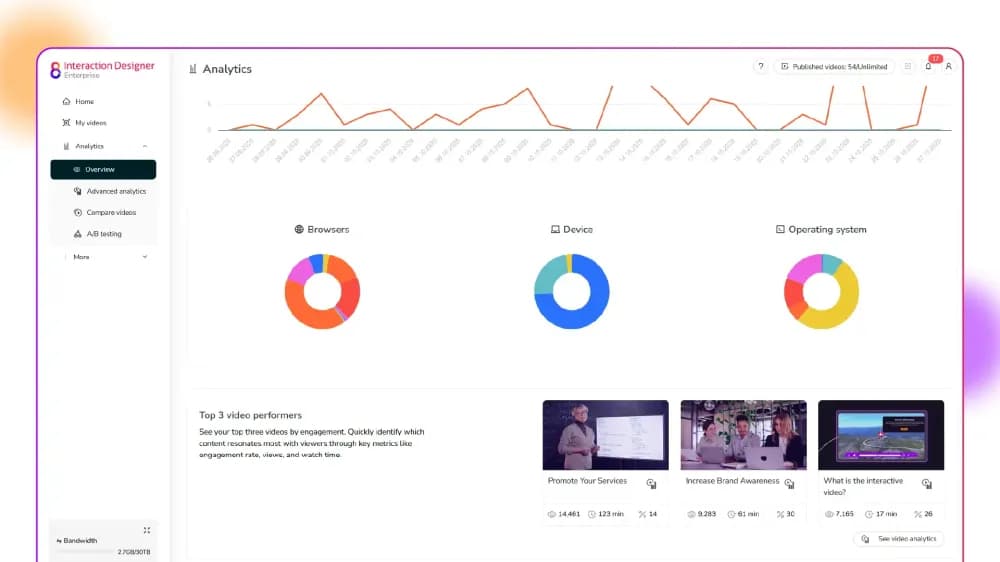
Video analytics mistakes are more common than most marketing teams realise, and more costly. Video analytics tools surface a significant amount of behavioural information, but the value of that information depends entirely on how it is interpreted and acted on. This article covers the seven most common video analytics mistakes that are costing marketing teams conversions, and how to avoid them.
Why video analytics mistakes are so costly for marketing teams
Video analytics mistakes are costly for marketing teams because, unlike a broken CTA or a failed campaign, analytics misinterpretation produces no visible error. Teams continue reporting on metrics that look reasonable, making decisions based on data that is telling them the wrong story, and missing conversion opportunities that better interpretation would have captured. This is particularly significant for teams using a video hosting platform with advanced analytics capabilities, where the data needed to make better decisions is already available but is not being used correctly.
The cost also compounds over time. A team that consistently optimises for the wrong video analytics metrics will invest in content that does not convert, deprioritise leads that are close to a decision, and struggle to build a credible business case for video investment. The seven mistakes below are the most common sources of that misalignment.
1. Optimising for view count instead of engagement quality
View count is the most visible video metric and one of the least useful for conversion. A video with a high view count but low engagement depth tells you that content reached an audience, but it does not tell you that it influenced that audience. The video analytics mistake many marketing teams make is optimising for views. It is natural to gravitate toward content that attracts attention, but this doesn't always translate to content that drives evaluation. The result is a video strategy that performs well on reach metrics and poorly on revenue ones. Engagement quality, measured through video analytics metrics like watch depth, interaction rate, and return viewing behaviour, is a far more reliable indicator of whether video is contributing to conversion.
2. Reading completion rate without considering content type
One of the most common video analytics mistakes is reading completion rate without the context of content type. A 90% completion rate on a 30-second brand video and a 90% completion rate on a 10-minute product demo are not equivalent signals. The first tells you that viewers did not abandon a short piece of content. The second tells you that a prospect invested significant attention in decision-stage material. Teams that report completion rate without segmenting by content type and length are misreading their video analytics metrics and will consistently draw the wrong conclusions from their data. Completion rate on decision-stage content is a meaningful conversion signal and a signal for calculating video ROI. Completion rate on awareness content is not.
3. Ignoring viewer-level data in favour of aggregate metrics
Aggregate metrics show you how a video performs across an entire audience, while viewer-level data shows how a specific prospect is behaving. For conversion, only one of these is actionable. A marketing team that knows 60% of viewers watched past the halfway point of a product demo has useful content feedback. A team that knows a specific contact watched that demo three times in 48 hours has a sales signal. This video analytics mistake is particularly costly because the data required to fix it is already available when you use a video hosting platform like Cinema8. Viewer-level tracking gives marketing and sales teams the ability to identify high-intent individuals and act on their behaviour before the moment of interest passes.
4. Treating drop-off as failure rather than a diagnostic signal
Drop-off is one of the most misread metrics in video analytics. When viewers stop watching, most marketing teams record it as a negative and move on. In reality, drop-off data is diagnostic. Consistent drop-off at the same point in a video reveals where messaging is losing relevance, where expectations are not being met, or where the content structure is creating friction. Late-stage drop-off, particularly after pricing or implementation sections, can indicate hesitation and may warrant targeted follow-up. This video analytics mistake is common because drop-off looks like a simple failure metric when it is actually one of the richest sources of commercial intelligence available.
5. Not connecting video analytics to your CRM
Video analytics that sit inside a video hosting platform and never connect to your CRM can limit your operational flow. While the valuable data exists, it cannot influence follow-up timing, lead scoring, or sales prioritisation. This video analytics mistake effectively siloes your most valuable behavioural data from the systems that need it most. When viewing behaviour is tied to individual contact records inside your CRM, it becomes a commercial signal that the rest of the business can act on. A prospect who watched a pricing walkthrough twice and clicked a demo CTA should surface in your CRM as a high-priority lead. Without CRM integration, that behaviour is invisible to everyone outside the video platform and the conversion opportunity may be lost.
6. Measuring video performance in isolation from the rest of the funnel
In businesses, and particularly in sales funnels, video does not operate as a standalone channel. A prospect who discovers a brand through an awareness video, returns to watch a product demo, and then books a call after viewing a case study has moved through the funnel with video at every stage. This video analytics mistake leads marketing teams to underestimate video's contribution because they are only crediting direct conversions rather than the full influence video has had on the decision. Connecting video analytics to broader funnel reporting, and using multi-touch attribution where possible, gives a more accurate picture of what video is actually contributing to revenue.
7. Failing to act on heatmap data
Video heatmaps show which sections of a video are watched most, rewatched, or skipped at both aggregate and individual viewer level. They are among the most actionable outputs of a video analytics platform and among the most underused. Failing to act on heatmap data is a video analytics mistake that costs teams in two ways. The first is content optimisation: sections that are consistently skipped signal weak messaging that should be revised. The second is conversion intelligence: viewers who repeatedly engage with pricing or feature sections are exhibiting evaluation behaviour that should trigger a sales response. Heatmap data bridges the gap between audience members simply viewing your content with no intent and viewing it with commercial intent, but only when it is reviewed and acted on.
Turning video analytics mistakes into conversion opportunities
The video analytics mistakes above share a common thread - they all involve treating video analytics as a reporting exercise rather than a decision-making tool. View counts, aggregate completion rates, and unconnected drop-off data tell you what happened. Viewer-level engagement, CRM-integrated behaviour, and heatmap patterns tell you what to do next.
Marketing teams that make this shift gain a clearer picture of which prospects are progressing toward a decision, which content is supporting that progression, and where conversions are being lost. Video analytics becomes less about demonstrating performance and more about driving it.
For teams looking to get more from their video analytics, Cinema8's video hosting platform provides viewer-level tracking, heatmap analytics, and CRM-ready integrations that turn behavioural data into actionable conversion intelligence.