As learning and development programmes grow in scale and complexity, the platforms that support them need to offer more than store and stream video. L&D teams are increasingly looking for solutions that support active learning, integrate with existing tools, and provide advanced analytics. This guide covers the key criteria for choosing an interactive video hosting platform for L&D, from core features to LMS compatibility.
How to evaluate an interactive video hosting platform
Not all video hosting platforms are built with learning in mind, and the difference becomes clear when L&D teams start looking beyond storage and streaming. Platforms that include interactive capabilities and built-in video analytics are a different category entirely, and evaluating them requires a different set of criteria.
A useful evaluation starts with four core questions:
- Does the platform support interactivity natively, meaning quizzes, branching scenarios, and clickable elements are built in rather than bolted on?
- Does it integrate cleanly with your LMS and existing learning ecosystem?
- Does it give you meaningful data on how learners engage with content, not just whether they watched it?
- Can it scale with your programme without creating additional management overhead?
These criteria matter because choosing an interactive video hosting platform for L&D is a long-term operational decision. A platform that meets all four gives L&D teams the foundation to deliver training that is consistent, measurable, and adaptable as programmes evolve. Cinema8 is built around these criteria, combining interactive video capabilities with enterprise-grade hosting and learner analytics in a single platform.
Why training teams switch to interactive video hosting
Employees can watch a training video from start to finish and retain very little, particularly when the content is dense or requires active application. Interactive video hosting for L&D addresses this by turning viewing into participation.
When learners are prompted to answer questions, make decisions in branching scenarios, or respond to in-video tasks, engagement increases and knowledge retention improves. Interactive formats also give L&D teams clearer signals of whether learning has taken place, because the content requires a response.
For training programmes covering compliance, onboarding, or role-specific skills, this distinction matters. A learner who has navigated a branching scenario or passed an embedded knowledge check has clear and demonstrated understanding.
Key features to look for in an interactive video hosting platform
Once you have a clear evaluation framework, the next step is knowing which specific capabilities to look for when comparing platforms. Not every platform that supports video interactivity is built for the demands of an L&D programme, so it is worth assessing each option against a defined feature set.
The core features to look for include:
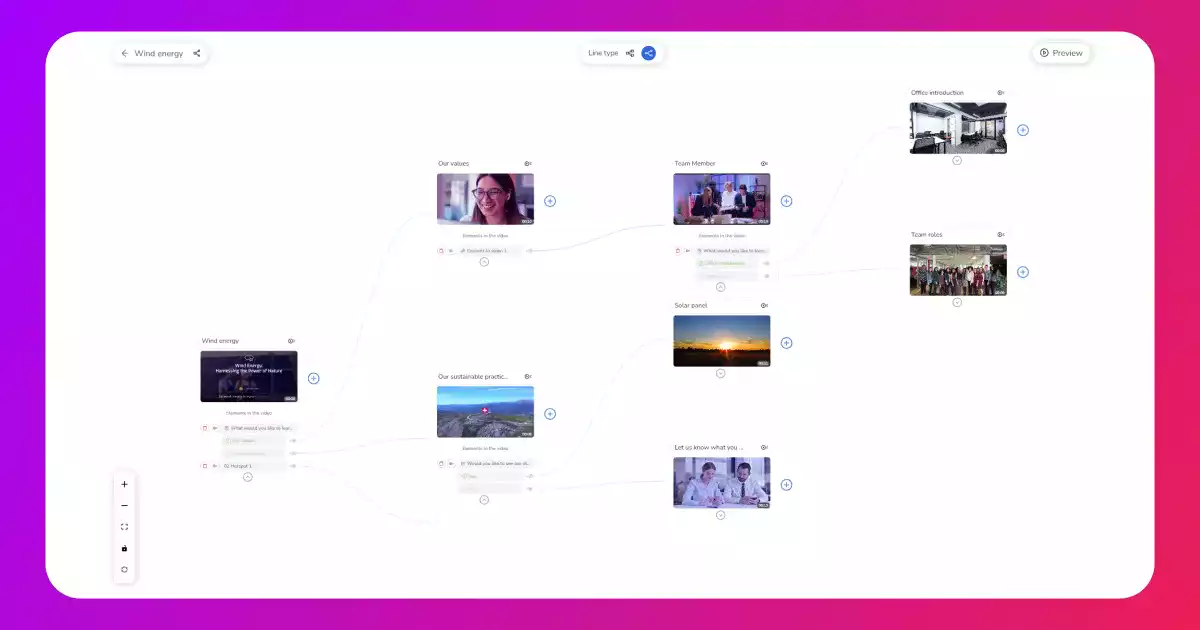
- Branching and scenario-based navigation: Employees follow different paths based on their responses, which is particularly valuable for compliance training and role-play simulations.
- Embedded quizzes and knowledge checks: Questions appear within the video itself, allowing L&D teams to assess understanding at the point of learning.
- Clickable hotspots and CTAs: Learners can interact with on-screen elements, access supplementary material, or be directed to further resources without leaving the video.
- Access control and permissions: Training content can be restricted by role, department, or location, ensuring the right people access the right material.
- SCORM and xAPI compatibility: Content can be tracked and reported within an LMS, which is essential for compliance programmes that require completion records.
Cinema8's video hosting platform supports all of these capabilities, allowing L&D teams to build, host, and measure interactive training content without managing multiple tools.
LMS integration and learning ecosystem compatibility
An interactive video hosting platform does not operate in isolation. For most L&D teams, it needs to work within an existing learning management system and sit alongside other tools that manage content, track completion, and report on training outcomes.
Good LMS integration means content behaves correctly within the LMS environment, completion data is passed back accurately, and learners do not have to leave their existing learning environment to access training. SCORM and xAPI are the standards that make this possible, and any platform being considered for enterprise L&D should support both.
It is also worth assessing how the platform handles content updates. When a video is edited or replaced, does the change reflect automatically wherever the content is embedded, or does it require manual updates across every course it appears in? For large programmes spanning multiple teams or regions, this is a significant operational consideration.
Analytics and visibility into learner engagement
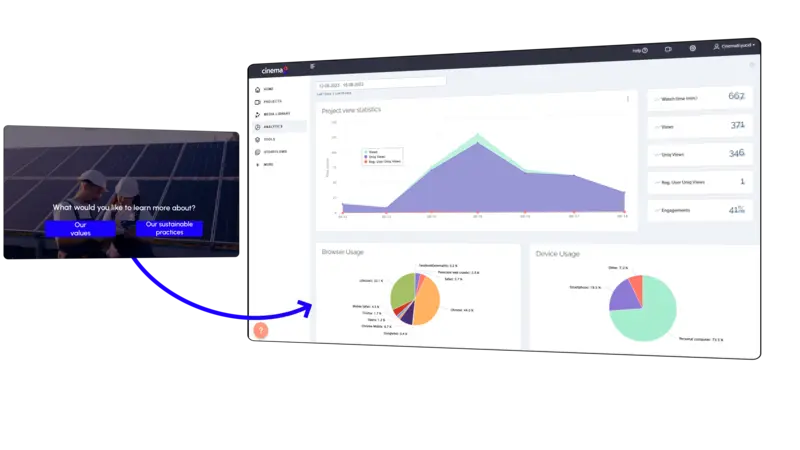
Interaction data tells L&D teams how employees responded to embedded questions, which paths they took through branching scenarios, and where they dropped off or rewatched content.
For programmes that need to demonstrate outcomes, this level of detail matters. It makes it easier to identify content that is not working: if a significant number of learners are failing a knowledge check at the same point, or consistently skipping a particular section, that signals a problem passive video data would not surface.
Cinema8's video analytics provide interaction-level data across all training content, giving L&D teams the visibility they need to improve programmes over time.
Why L&D teams choose Cinema8 for interactive video hosting
Cinema8 is a video hosting platform with interactive capabilities. It is built to support the full range of L&D requirements, from onboarding and compliance to role-specific training and continuous development. It brings together the capabilities covered in this guide, interactive content tools, LMS integration, access control, and learner analytics, within a single platform.
L&D teams can build branching scenarios, embed knowledge checks, and control access by role or department without managing multiple tools. Training content integrates directly into existing LMS environments via SCORM and xAPI, and updates made in Cinema8 are reflected wherever content is embedded, keeping programmes accurate without additional management overhead.
The analytics give teams visibility into how learners interact with content at every stage of the training process. This makes it easier to identify gaps, improve underperforming content, and demonstrate the impact of training over time.
How video hosting platforms enable long-term L&D growth
Choosing an interactive video hosting platform for L&D is a decision that affects how training is delivered, measured, and improved across the organisation. The right platform supports interactivity as a core capability, integrates cleanly with existing learning systems, and provides detailed analytics.
For L&D and HR teams working through that decision, the criteria covered in this guide provide a practical framework for comparing options and identifying the platform that best fits how your organisation delivers training. Explore Cinema8's plans to see how it supports interactive video hosting for L&D at scale.