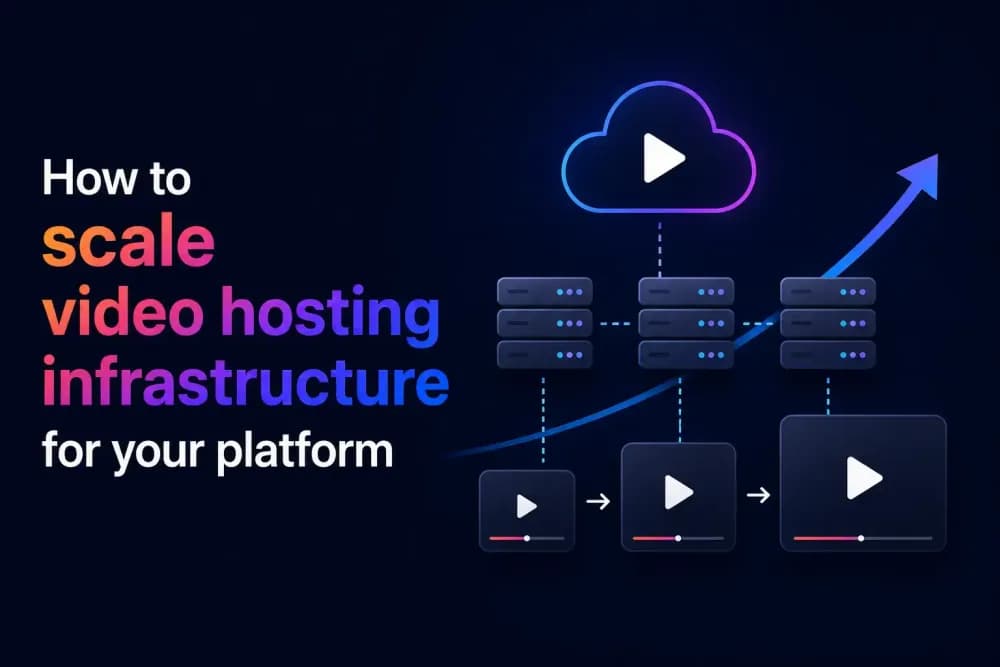
Scaling video hosting infrastructure means redesigning your encoding pipeline, CDN strategy, and access layer before traffic exposes their limits. Many platforms hit the same failure points in the same order: encoding queues, CDN cost spikes, and analytics that lose resolution at scale. This guide covers the infrastructure decisions that prevent each one from becoming a crisis.
What does scaling video hosting infrastructure involve?
Scaling video hosting infrastructure means keeping delivery performance consistent as concurrent viewers, video library size, and geographic reach all increase at the same time. The three systems that determine whether you scale cleanly or run into trouble are your encoding pipeline, your CDN configuration, and your access control layer.
Platform teams that adopt a scalable video hosting solution before they need it tend to avoid the migration work that hits teams who outgrow a basic setup mid-growth. A CDN that handles 1,000 concurrent viewers will show its limits at 50,000. An encoding pipeline built for 10 uploads a day breaks down when 200 uploads arrive on the same morning. An analytics setup that reports simple view counts becomes useless when your product team needs to know at which minute specific viewer segments stop watching.
The platforms that scale without crisis treat encoding, delivery, and analytics as interconnected systems rather than separate decisions. What happens in the encoding pipeline directly affects delivery quality, and what happens in delivery directly affects what your analytics data can tell you. Getting one right while neglecting the others creates a bottleneck that can appear at the worst possible time.
What breaks first when your video hosting can't keep up?
Encoding is almost always the first failure point for video hosting platforms that aren't built for scalability. When upload volume increases faster than your transcoding pipeline can process it, videos queue and viewers waiting for content that has not finished encoding get a broken experience. A pipeline that runs multiple transcoding jobs simultaneously and adjusts to real upload patterns handles volume spikes without queuing.
CDN costs are the second inflection point, but CDN performance affects engagement long before it shows up on an invoice. A CDN caches video segments close to the viewer, reducing latency and the load on your origin server. As your video library grows, cache efficiency drops. Videos with low view counts stop being cached, and every request hits your origin directly. Knowing which videos are watched frequently and which are not lets you configure caching rules that keep both delivery quality and bandwidth costs predictable as your library grows.
Buffering is the symptom users notice, and the cause is usually poor adaptive bitrate configuration rather than raw bandwidth shortage. Adaptive bitrate streaming produces multiple versions of each video at different quality levels. The player then selects the right rendition based on the viewer's current connection speed. Without it, every viewer receives the same stream regardless of their network. At low scale this is a quality issue. At higher scale it is both a delivery cost issue and a churn risk.
The fourth failure point is analytics. Most video hosting setups capture data at the asset level: total plays, total watch time, overall completion rate. That works when your library is small and your decisions are broad. At scale, the questions get more specific: which viewers are churning at a particular point in a particular video, and whether that pattern holds across regions or devices. Per-viewer session data is what makes those questions answerable.
What are the components of scalable video hosting infrastructure?
The decisions that matter most at scale are made before traffic arrives. A video hosting infrastructure designed for growth needs five components working together.
- Multi-bitrate encoding produces multiple versions of each uploaded video at different resolutions and bitrates, from 360p for low-bandwidth environments to 1080p and above. Adaptive bitrate streaming then selects the right rendition per viewer per session based on live network conditions.
- Multi-CDN delivery routes traffic to the nearest available point of presence and fails over automatically if one provider has a regional outage. Platforms using a single CDN lose delivery to the affected region until the issue resolves.
- Storage tiering separates frequently accessed content from archived video. A tiering policy that moves rarely watched videos to cold storage reduces costs without affecting delivery speed for popular content, because the CDN cache layer handles those requests regardless.
- Access controls cover domain restrictions, IP restrictions, expiring links, and SSO integration. These are baseline requirements for any platform serving gated content, subscription video, or restricted internal communications.
- Viewer-level analytics track engagement at the session level. Per-viewer data tells you where specific groups of viewers stop watching and which content holds attention across regions and devices. Infrastructure decisions made on asset-level totals alone are working from an incomplete picture.
What to verify before committing to a video hosting platform at scale
Choosing a video hosting platform for a growing product is a different decision from choosing one for an early-stage team. The gaps that matter most are rarely visible in a demo: which analytics tier actually includes per-viewer session data, what happens to delivery when you hit a bandwidth ceiling, and which access controls are restricted to enterprise plans. Knowing the right questions to ask a video hosting provider before you commit saves the kind of migration work this article has been describing.
Cinema8 is a secure video hosting platform that supports playback up to 8K with HDR, per-viewer engagement analytics, SSO, domain and IP restrictions, expiring links, webhooks, and FTP upload. Cinema8 scales from free-plan individuals to enterprise teams, with a 14-day free trial on all paid plans and no credit card required.
What to get right before your video infrastructure becomes a bottleneck
The right time to review your video hosting infrastructure is before growth exposes its limits. Teams that select a platform for their current scale tend to hit the same ceiling at a predictable point in their growth curve, and the migration work that follows consumes engineering capacity that should be going toward the product itself.
Cinema8's domain restrictions, SSO, and expiring links give platform teams access control that scales alongside their user base without requiring a separate security layer. For teams whose video activity needs to feed downstream into a CRM or product analytics tool, Cinema8's webhook support handles that without additional configuration.
If your current video setup is approaching its limits, mapping your infrastructure requirements now is considerably cheaper than mapping them after a failure.