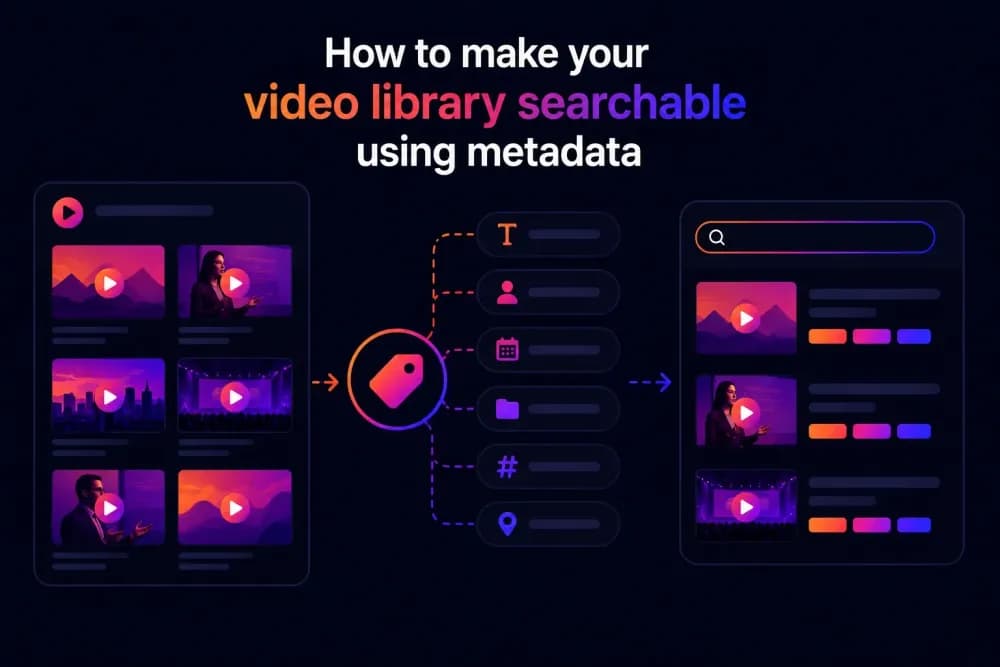
A searchable video library depends on one thing: the quality of metadata attached to each asset. Titles, descriptions, transcripts, and chapter data let people and machines find the right video. Strong metadata serves two audiences: your team finds what they need in seconds, and search engines surface your content to the right viewers. This guide covers what to add, how discoverability works, and the failure modes that break both.
What is video metadata and why does it control discoverability?
Video metadata is the descriptive, structural, and technical information attached to a video file or its hosting page. It is the layer that lets software understand content a player would otherwise treat as an opaque file. Cinema8, the secure video hosting platform, generates and structures this layer so every asset in your library carries the data needed to be found. You can route a finished library straight into secure video hosting, where that metadata stays attached to the asset. It does not live in a separate spreadsheet that drifts out of date.
Search engines cannot watch a video. They read what surrounds it. A video exported from your editor and uploaded without a title, description, or transcript is invisible to both search engines and your own team's search bar. A title, description, and transcript built around a real query tell search engines exactly what the footage covers. The same logic now governs AI retrieval. Perplexity, ChatGPT, and Gemini cite video pages when the text around the player answers a specific question clearly.
What are the three types of video metadata?
Metadata splits into three working types, and each one does a different job. Understanding the distinction is important because the type determines where the data appears, who reads it, and what breaks when it is missing. Each type plays a different role in whether a video gets found, navigated, or governed correctly.
- Descriptive metadata: This includes the title, description, video tags, keywords, and transcript that state what a video is about. It is the working type that controls whether a video matches a query. A customer onboarding video tagged with the product name, the onboarding stage, and the target role is findable by a teammate and a search engine alike. The same video with no description is invisible to both. Transcripts deserve specific attention because they are the largest block of descriptive text most videos can carry. A ten-minute video transcribed produces over a thousand words of indexable, query-matching content. Cinema8 generates subtitles in over 100 languages, and that subtitle text doubles as transcript metadata that search engines and in-library search can read.
- Structural metadata: This divides a video into chapters, segments, and scenes so viewers and search tools can jump to a specific moment. It matters most for long-form content where the answer a viewer wants sits eight minutes in. Chapter markers let Google surface a key moment directly in results, and they let a viewer skip to the part that applies to them. Cinema8 includes AI chapter suggestions that split a video into chapters based on content flow. This removes the manual work that stops most teams from chaptering at all.
- Administrative metadata: This covers rights, access permissions, upload dates, owners, and technical specifications. It rarely affects public search, but it stops a large internal library from collapsing into chaos. When five teams upload to one platform, owner and permission metadata does the sorting. It lets the right people find and reuse the right assets without exposing restricted footage.
How is internal library search different from external discoverability?
Internal library search helps your own team find a video they know exists. External discoverability helps strangers find a video they did not know existed. These are two different problems, and most advice on this topic treats them separately rather than showing how the same metadata layer solves both at once.
The internal problem is retrieval inside a known set. A marketer needs last quarter's webinar. A sales rep needs the demo for a specific feature. An L&D lead needs the compliance module recorded in March. If the library has no tags, no folders, and no searchable transcripts, that retrieval turns into scrolling through thumbnails or asking a colleague. That is a common enough problem that it regularly drives teams to look for a new platform entirely, instead of fixing the metadata on the one they have.
The external problem is matching content to demand you have not captured yet. Here the metadata has to align with how people actually phrase searches, not how your team names files internally. A video your team calls "Q3 product walkthrough" might need a different public title entirely. Build it around "how to set up automated reporting" because that is the query buyers are more likely to type.
The fix is to design metadata for both audiences from the start. Use human-readable internal labels plus query-aligned public metadata, both attached to the same asset. That is what makes a video library searchable with metadata working in both directions at once. Cinema8 generates SEO-friendly titles, tags, and summaries so the public-facing metadata can differ from your internal naming while staying accurate.
What metadata fields have the biggest impact on whether a video gets found?
The metadata fields with the biggest impact on video discoverability are the title, the description, the transcript, and chapter markers, in roughly that order. These four carry most of the signal that search engines and library search use to match a video to a query. The remaining fields refine and govern, but these four decide findability.
The title carries the most weight per word. Search engines display it as the result headline, and library search ranks it heavily. Place the primary phrase early, keep it descriptive, and never leave an auto-generated export name as the title.
The description gives context the title cannot fit. This is where supporting phrases, the use case, and the audience get stated in full sentences. A strong description reads like a short honest summary of the video rather than a keyword list. Search engines penalise stuffed descriptions, and viewers ignore them.
The transcript is the largest indexable surface a video has. Every spoken sentence becomes matchable text. A video with a transcript can rank for phrases its author never thought to add as tags, because the speaker said them naturally on camera.
Chapter markers turn one asset into many findable moments. Each chapter is a labelled, jumpable segment that search tools can surface independently. For any video over a few minutes, chapters are the difference between "we have a video about that" and "here is the exact ninety seconds you need."
Tags and categories connect related videos. They are weaker than the four fields above for direct matching, but they power filtered browsing and related-video surfacing inside a library. Consistent tagging is what lets a viewer move from one relevant asset to the next without starting a new search.
Why do video libraries become unsearchable as they grow?
Video libraries become unsearchable because metadata discipline breaks down at exactly the point a library gets large enough to need it. The point of failure is rarely a missing feature. It is more often caused by inconsistent, incomplete, or stale data accumulating faster than anyone cleans it. The patterns below are the ones that most reliably degrade a library until search stops working:
- Tag drift is one of the most damaging and least visible problems. Three uploaders tag the same concept three different ways, and the library splits into clusters that never surface together. "Onboarding," "on-boarding," and "new user setup" become separate silos. Without a shared tagging convention agreed before the library grows, search returns a fraction of the relevant results and nobody can easily diagnose why.
- Stale metadata after content changes misdirects search rather than returning no results, which makes it harder to spot. A video updated for a new product version keeps its old title, description, and chapters. Search confidently returns it for the right query, but the viewer arrives to find content that no longer reflects reality. Metadata needs the same review cadence as the content it describes.
- Permission gaps hide assets from the people who need them. In a multi-team library, missing or wrong access metadata means a video exists but the right viewer cannot find it. The asset is in the library and invisible at the same time. Cinema8 handles this with viewer-level permissions, domain and IP restrictions, and SSO, so access control organises the library rather than obstructing it.
Cinema8 scales from free-plan individuals to enterprise teams with SSO, domain restrictions, and unlimited seats. A library can grow without the metadata model breaking.
How does metadata help AI search tools find and cite your videos?
Metadata helps AI search tools because of how they read video. Tools like Perplexity, ChatGPT, and Gemini retrieve and cite the text attached to a video, not the footage itself. A video page with a clear title, a full description, and a complete transcript gives these tools clean, quotable text to extract and attribute. A page with thin metadata gives them nothing to cite.
The mechanics mirror traditional SEO but reward depth more. AI tools favour content that answers a specific question in self-contained, extractable statements. A transcript that states a fact plainly is easier to cite than the same fact buried in a long unstructured paragraph. Chapter labels phrased as real questions give AI tools clear extraction points across a single video.
How do you keep a large video library searchable as you scale?
Keeping a searchable video library running well at scale is an ongoing practice. The work is to apply a consistent metadata model at upload and review it on a schedule, so data quality keeps pace with library growth.
Start every upload with a real title and description. Make the title describe the content in the words a searcher would use, and write the description as a short honest summary. Generate a transcript for every video so the largest indexable surface is never left empty. Add chapters to anything over a few minutes. Set a tagging convention before the library grows, and apply it consistently. Do not allow each uploader to invent their own.
Keeping metadata current is the second part of the practice. Re-check it when content changes, retire stale tags, and audit the library periodically for missing transcripts that slipped through. A library stays searchable because someone keeps the metadata honest, not because the search tool is powerful. The tool can only match what the metadata describes.
Good metadata separates a searchable library from a growing archive
Most video libraries become hard to search because the metadata underneath them was never treated as something worth maintaining. Titles get skipped, transcripts never get generated, tags drift, and stale descriptions pile up. The library grows and the problem compounds quietly.
Cinema8's video hosting platform closes that gap at the point of upload through AI tagging and summaries, AI chapter suggestions, and subtitle generation in over 100 languages. The metadata that makes a library searchable gets created without the manual effort that usually stops teams from doing it, and that same layer feeds search engines and AI tools simultaneously.
The practical starting point is simpler than most teams expect. Look at your own library and count how many assets still carry an auto-generated name as a title. That number tells you most of what you need to know.